
Choose your hard: Christina Vithoulkas, Australia’s first female para drift driver
6 November 2026
Inform Magazine
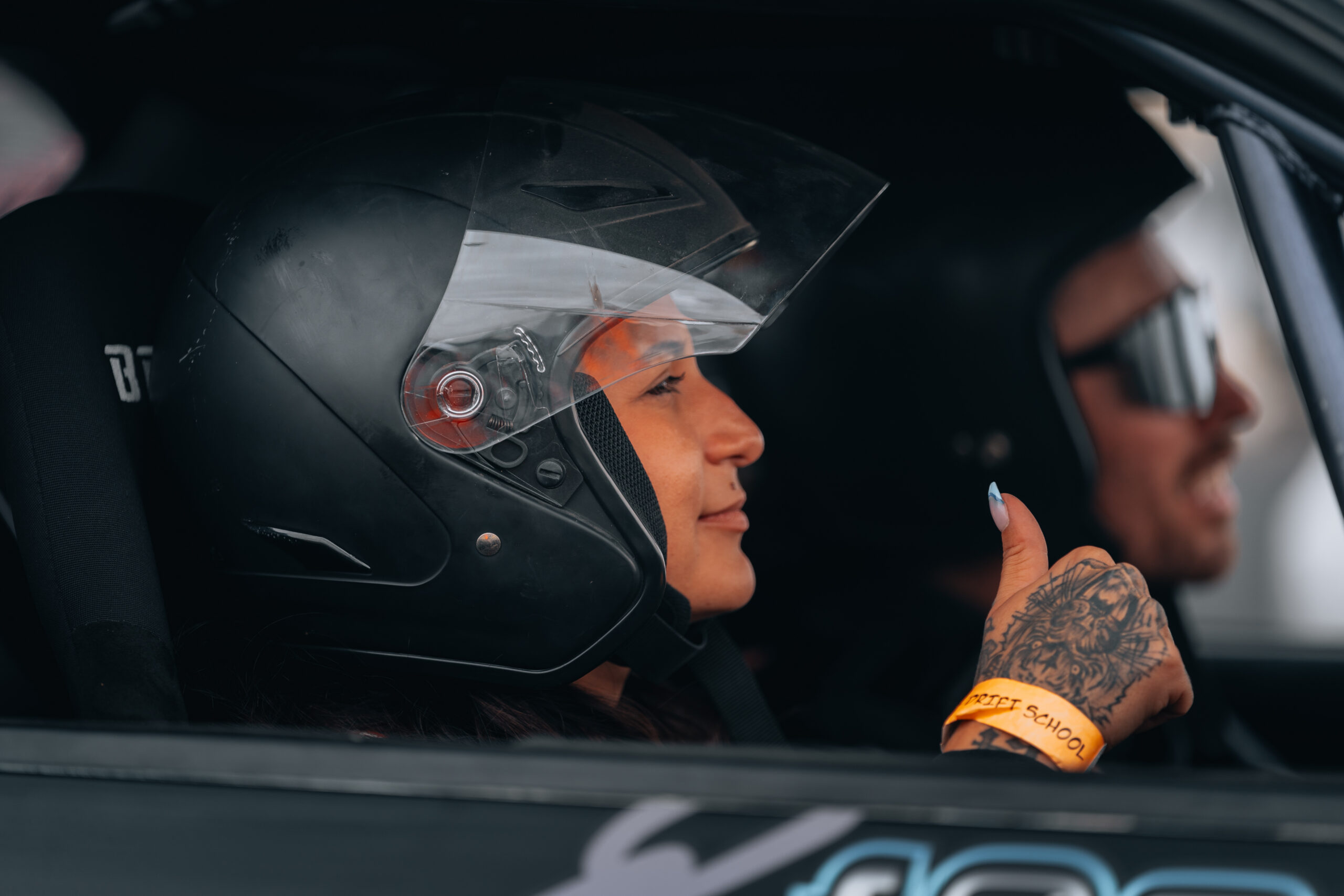
Christina Vithoulkas was one of Australia’s first female freestyle motocross riders. Then a mistimed jump changed everything. Now she’s Australia’s first female para-drifter, and she says her disability is the best thing that ever happened to her. This is her story, in her words.
Christina Vithoulkas grew up on a 20-acre vineyard in Barmera, a small town in South Australia’s Riverland, with her twin sister Irene, her mum who was a teacher, and her dad who grew grapes. It was a full Greek family, and like a lot of country kids, she spent most of her time outdoors, climbing trees and catching bugs.
What she didn’t have, growing up, was a passion. She tried ballet, taekwondo, and soccer. She was good at soccer, even winning best and fairest in her first year. She just didn’t care about it.
“I knew I had passion in me,” she says. “I just didn’t have anything to practice it on. I knew that if I found something, I would put 110% effort into it. I just couldn’t find that thing.”
She found it at 19, when she got on the back of a dirt bike and two weeks later bought her own. She started riding three times a week, then racing, then freestyle motocross, hitting 55-foot gaps on ramps. She was one of a handful of women in Australia doing it, and the only one in South Australia. Then, in September 2018, on a day that tarted like any other, she misjudged a jump.
The day everything changed
Christina was visiting family in South Australia and went to support a mate’s track opening day. She did her usual routine: sign in, get ready, stretch, speed checks. But something felt off. There were loose rocks near the ramp. She didn’t feel confident.
She hit the ramp anyway, with less speed than she needed, and landed on the top of the deck instead of the down ramp. The bike bounced. Her legs flew over her head. She landed on her neck and shoulder, and her body folded in half.
Her friends heard her back break from 20 metres away. When she came to, she was in the most pain she had ever experienced. She looked down at her legs and watched her ex-boyfriend touching them, and she knew she couldn’t feel it.
“I was so certain,” she says. “I’m going to be in a wheelchair. I am definitely paralysed. I’ve done the job properly this time.”
Her sister says she saw the moment Christina accepted it. A little chin wobble, like she was about to cry. And then nothing. She just sat there.
The mindset
Christina didn’t grieve. She didn’t spiral. She accepted it, almost instantly, and started visualising her life with a wheelchair attached to her. Not a different life. The same life, with a wheelchair.
“I just visualised: it’s fine. I’m still me and I’m still going to do everything that I want. I’m just going to have a wheelchair attached to me. That’s the only difference.”
She knows this isn’t normal. She’s questioned it herself, wondered if she’s delusional. But she’s found her answer, and it comes down to two things.
The first is her dad. Growing up, every trip to the supermarket, he would tell his daughters how lucky they were: a full trolley, a roof over their heads, richer than most people in the world. It was annoying as a kid. As an adult, she realises he was building a glass-half-full blueprint into them that was already wired in before the accident.
The second is a theory she found words for in a TED talk. Being 99% committed to a decision is harder than being 100% committed, because 100% doesn’t leave room for negotiation.
“That’s exactly what I did,” Christina says. “I made a decision, 100% committed, that this was going to be the best thing that ever happened to me. On day one in ICU. And because I was so certain, all these doors that had closed on me, I was like, I don’t care. I’m going around to the next door.”
She did have moments of grief. But they weren’t about the injury itself. They were about the things around it, and more than anything, the relationship she was in at the time which she describes as toxic.
“I was crying nearly every day. Nothing to do with my injury. And that was my reality check. I’m crying over a boy and I’m freshly paralysed, dealing with toileting challenges, and I’m not crying about that. I’m crying over a boy. And I was like, no. Enough.”
She left the relationship, moved back to South Australia, and that’s why she calls the accident the biggest blessing of her life. It gave her the strength to leave that bad relationship, and to learn to love herself properly.
Finding the fire again
About a year after the accident, someone Christina didn’t know reached out on social media and asked if she wanted to come drifting. She had no idea what drifting was. She said yes, because by then she had become the ‘yes-woman’, saying yes to every opportunity that came her way.
The first lap, going sideways as a passenger, she felt something she hadn’t felt since the dirt bike. The same fire. The same adrenaline. The same feeling of being alive.
“I had no idea that the first time I would go drifting I was going to completely fall in love and have that same fire in my soul that the dirt bike gave me,” she says. “Knowing that same adrenaline rush was achievable in a drift car was like hitting the jackpot. I’m paralysed, but I’ve got a second chance at life, a second chance of living the same type of life.”
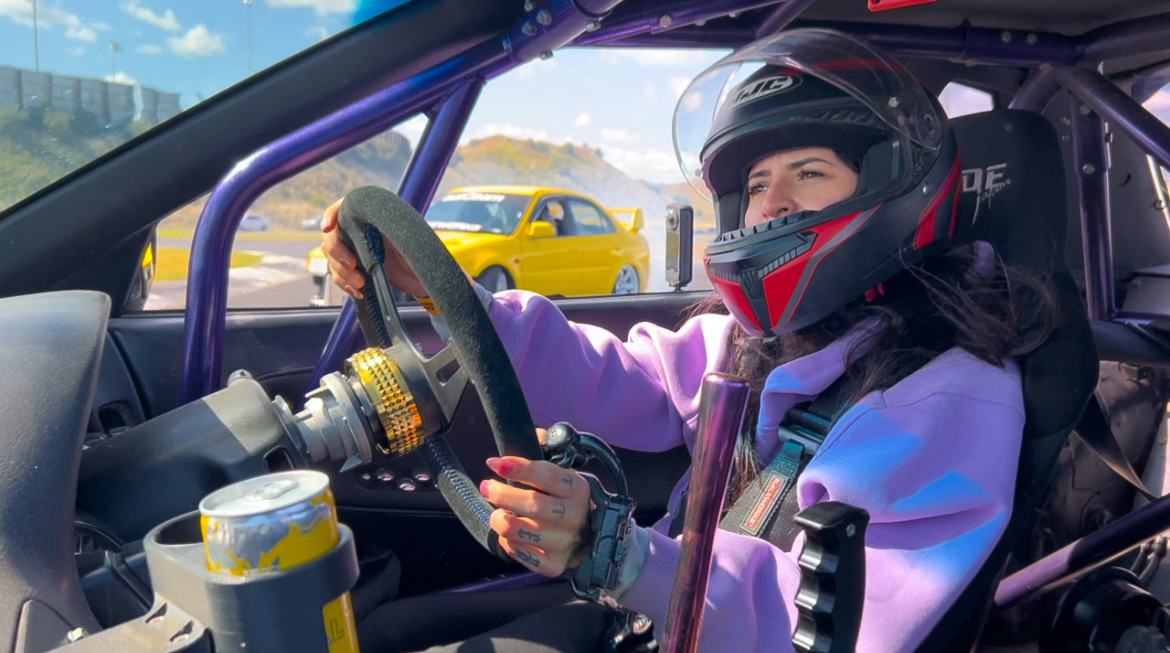
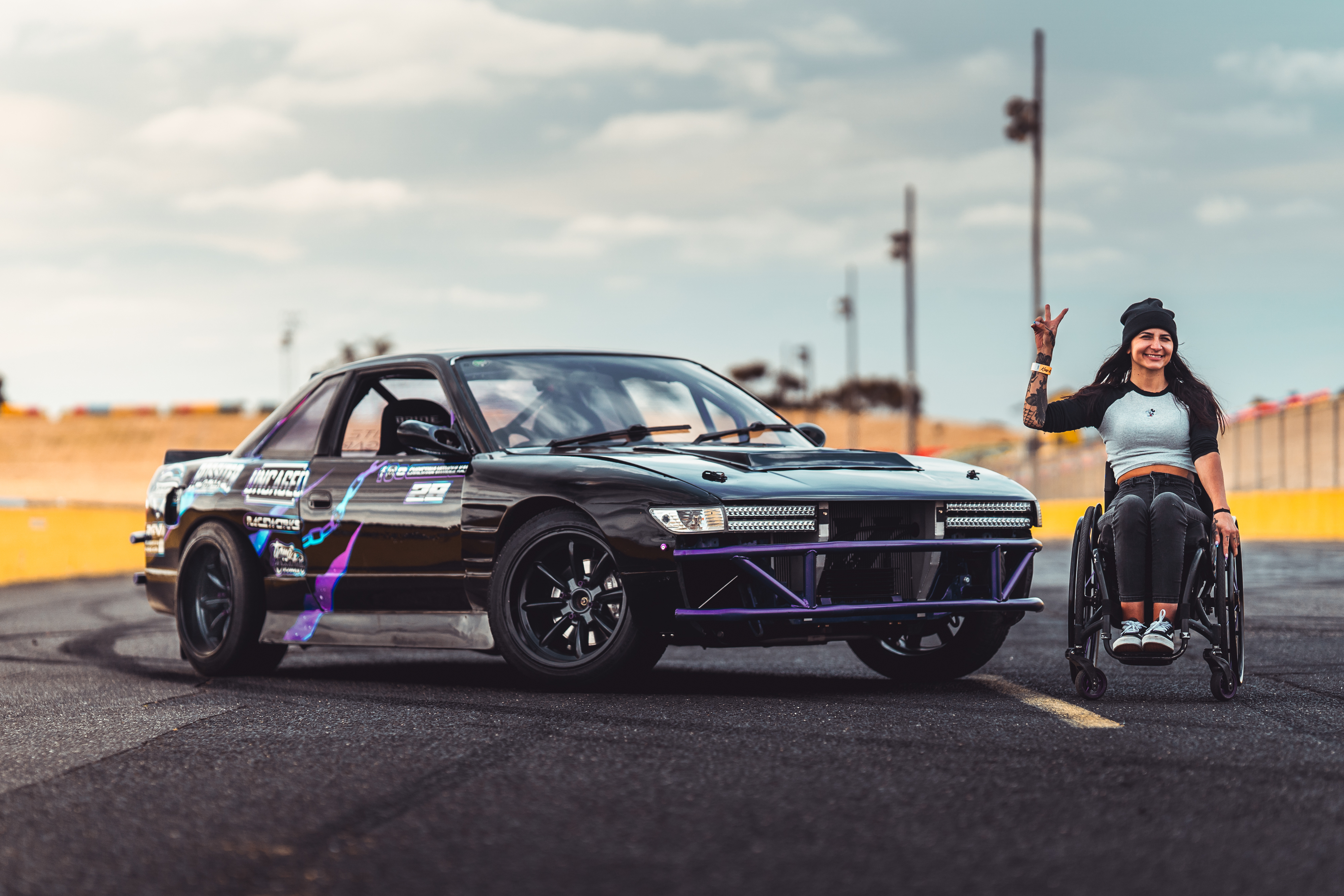
Two weeks later, she bought a Nissan Silvia S13 in Tasmania. COVID hit, so she waited eight months to collect it. Then she spent three and a half years and roughly $80,000 building it. The whole time, she held onto the feeling from that first lap as a passenger, knowing that if that’s what it felt like as a passenger, she knew what it would feel like as a driver.
The car is a V8 with a turbo 400 auto gearbox. No clutch. No handbrake. The hand controls are Bluetooth satellite. Instead of a sensor in a foot pedal, the sensor sits in a hand control lever that Christina operates with her thumb. It sends a wireless signal to the car’s computer, telling it how much throttle to give. Everything that most drifters do with their feet and their left hand, she does with her hands alone.
The one place she feels free
When Christina talks about drifting, the word that comes up most is ‘free.’ In the drift car, she never thinks about her disability. She’s not segregated. She’s not doing a modified version of a sport alongside other disabled people. She’s out on the track with her non-disabled friends, doing the same thing they do, at the same level.
She can’t think of another sport where a person who uses a wheelchair can compete alongside non-disabled people without being separated. That’s what makes drifting different. That’s what makes it feel like her life before the accident.
“In the drift scene, I’ve actually never had to think about my disability,” she says. “It’s the only thing I can go out and do without feeling like I’m at a disadvantage. I just go do what anyone else has to do.”
First in Australia, second in the world
Christina didn’t set out to be the first female para-drifter in Australia. She didn’t even know she was until someone asked her and she Googled it. There was one woman in Europe. No one in Australia.
The title matters to her now, not for the accolade, but for the influence. She knows the power of showing people how fun something is. She did it with motocross, watching girls follow her into the sport and grow the community. She’s doing it again with drifting.
“I know there’s disabled people that are going to look at me and be like, well, if she can do it, I can do it. It’s an honour to be able to demonstrate that for people.”
She has 365,000 followers across TikTok, Facebook, and Instagram. For the disabled community, she wants to be an example of someone who said no to everyone’s expectations and did things regardless. For non-disabled people, she’s happy to be used as inspiration if it pushes them to try something.
“Use me for whatever you need,” she says. “If it’s going to inspire you to try something, if you’re going to look at me and be like, well, she’s doing it, what’s my excuse? Good. I hope that’s the case.”
We don’t need fixing
Christina is an ambassador for the Red Bull Wings for Life World Run, a global event that raises funds for spinal cord injury research. She was approached about the role while still in hospital.
She was hesitant at first. The idea of promoting a cure for paralysis felt conflicting. She doesn’t see herself as someone who needs fixing. She doesn’t believe her identity is built around finding a cure and learning to walk again. But she took on the role, and uses it to share a message that matters to her.
“We don’t need fixing,” she says. “Wouldn’t it be cool if you could walk again? Sure. It’s a bonus. It’s not like our whole identity is to need to be fixed and find a cure and learn to walk again.”
The event itself is something she genuinely loves. Thousands of people running, using their legs for what they’re designed for, appreciating them, running for people who can’t. She gets to be out there in her wheelchair, rolling alongside them, part of it.
What’s next
Christina’s future plans are deliberately loose. She doesn’t do five or ten-year plans. She believes she’s here today because she didn’t have a plan, she just said yes to everything.
But there are a few things she’s working toward. She wants to build a second drift car, so her current car can become a dedicated car for other people with a disability to try drifting. Getting into drifting as a person with disability is not as accessible as it is for a non-disabled person. She wants to change that.
She’d love to ship the car to America in the next few years. And public speaking is becoming her main focus. She finds it genuinely fulfilling, more than anything else she’s doing, and she’s starting to realise that’s where she wants to direct her focus.
“I don’t like to think any further ahead,” she says. “If I had that mindset when I was paralysed and I thought, what’s my five-year plan, I might not be here today. I’m here today because I didn’t have a plan and I just said yes to everything.”
The person who saw her soul
Outside of motorsport, Christina’s joy is simple. Her partner, Jesse. Her dogs. Laying in bed. Learning new things, watching TED talks. Meeting new people, which she describes as her genuine high.
Jesse is non-disabled, and he’s the only person she’s met since the injury who never spoke to her about her disability. He never brought it up. Never asked about it. Never gave it any attention. And that, she says, made her feel like herself.
“This guy sees me for my soul, not for what everyone else sees,” she says. “My relationship with Jesse isn’t based on my disability. It’s how I treat him as a person and who I am as a person.”
Choose your hard
Christina Vithoulkas’s story is not one about overcoming adversity. She’d be the first to tell you that. She didn’t overcome anything. She made a decision, on day one in ICU, that this was going to be the best thing that ever happened to her, and she committed to it 100%.
She still has hard days. She still has moments. But she’s chosen her hard, and she’s at peace with it.
“Waking up every day being depressed and struggling with mental health is the hardest thing you could do,” she says. “So as much as being positive and doing all these things that help me is hard, it’s not as hard as that. So that’s why I say: choose your hard. I chose my hard and it’s worked out well.”
Watch Christina’s video interview
Hear Christina talk about her accident, her mindset, and what life looks like when you take the wheel on your own terms.